Shades of Pet-Friendly

dogs, travel, Uncategorized

Lucy at sunset, Sturgeon Bay, Wisconsin

Fayston, Vermont. In my last post, I wrote about my upcoming road trip with dog Lucy and my college-age son to visit my parents in the Midwest. The trip involved crossing the US-Canadian border and hotel stays in several different locations. The trip went well, most of the time. Here’s what I found:

Border Crossings
My research told me that I needed to bring Lucy’s health and rabies shot records, $30 to pay the Canadian fee crossing into Canada, and her food in its original bag so that the ingredients could be easily determined. What actually happened is that I was not asked about the dog at all. No fee collected. No need to show health papers. No search to determine food ingredients. Most of the border agents’ questions were regarding weapons, which I did not bring. I didn’t even bring my golf clubs or a fishing rod. We enjoyed unremarkable crossings.

Having Lucy along likely made the crossings easier.  On our return across the border into Vermont, the United States agent asked the usual questions in the usual no-nonsense-just-the-facts-ma’am manner. Until he asked me to roll down the back seat window and met Lucy. His face morphed into a giant relaxed smile as he reached into our car to pet Lucy. Lucy wagged with excitement. “Welcome home,” he said and waved us through. As we drove off, he shouted: “I love Lucy!”

Lodging
I made most of our hotel arrangements well ahead of our trip.  I searched for pet-friendly hotels, and Best Western made it easy with most locations listed as such. I also used BringFido.com, through which I found a boutique hotel, the Old Stone Inn, in Niagara Falls, Ontario for our first night.

img_5871

The Old Stone Inn’s courtyard

I highly recommend The Old Stone Inn in Niagara Falls, on the Canadian side.  Lucy was warmly welcomed with a special gift of a travel dog dish, treats, and souvenir door hanger.  The room was large and the beds were deemed “the most comfortable ever” by my son.  We were allowed to leave Lucy in the room – I had brought her crate – while we walked around the falls.  We ate a delicious supper of burgers and local brews from the hotel’s pub in the attractive courtyard. The hotel’s location was ideal: just a short walk down a wooded path to the falls. The hotel was charming and the staff was friendly.  We were off to a great start!


After a long day of driving, we made it to Indiana, where I had made a reservation in a Best Western just off of I-80 near Chicago. Pet-friendly meant something else here. Upon arrival, I was asked to sign a pet agreement, part of which was to have our room inspected by a maid before we were allowed to check out. Dogs were not supposed to be left alone in the room, but when I said I had a crate, they didn’t press the point. We were tired and didn’t want to leave the room that evening anyway. Where would we go? Instead, we devoured a delivered pizza and enjoyed local brews from the hotel bar. We could hear another small dog barking all evening and into the night (wonder if the dog was left in the room alone?) but luckily Lucy did not bark in return. The maid was afraid of Lucy, but we passed inspection.

After several days staying at my mom’s house, we were back in the car headed to Sturgeon Bay, in Door County, Wisconsin and another Best Western to meet up with my dad and step-mom. Again, I was presented with the dog agreement at check-in, but this time the staff person was adamant that I do not leave the dog in the room alone, under any circumstances – not even to go to breakfast, which was included in our room fee. No maid inspection requirement at this property, however.

I was flustered and frustrated. My dad and step-mom were staying in the same hotel – that was the point. We planned to stay three nights. I was not told of the pet policy details when I made my reservations through the Best Western central reservation toll-free number, and I didn’t know what to ask at the time. But not being able to leave Lucy for a few hours was not going to work with the activities my family wanted to do. Add to that, we were assigned a room right next to the pool and the breakfast room. Bacon smells, kid noise, and water splashing sounds and they expect my golden retriever to not bark?! I canceled the last two nights and plugged in my computer to find another hotel.

Using the pet-friendly filter at Expedia.com, I found a room at The White Birch Inn. The room’s decor was something of a marvel, locked in the late 1980’s-early 1990’s, with mauve carpeting and wallpaper borders. But I would be allowed to leave Lucy in the room if I left my cell number. At check-in, I was given a token for a free drink from the bar. Breakfast was continental, and the first day, I enjoyed a bowl of beautiful fresh berries. The room was large and clean, and the price was right.

img_6533

Lucy in front of one of the many murals in Sudbury, Ontario.  The murals are created as part of an annual music and art festival.

Our last night of the trip was also in a Best Western in Sudbury, Ontario. The hotel is located on the same street as the police station and across the street from a small park. Again I was given a pet policy form to sign upon arrival, but leaving the dog in our 5th-floor room while we went to breakfast on the first floor was o.k. Or we could go just about anywhere else, as long as no one complained about the dog barking. The desk manager laughed when I told her about the room inspection clause I encountered in Indiana. As Best Westerns are independently owned, she explained, the pet policy (and its enforcement) varies from property to property.


The Lodging Upshot
Smaller inns will likely have more generous pet policies. It takes a bit more time to comb through search sites and requires a few extra telephone calls to find a good fit. Know what you are going to be doing helps filter, too – the Sturgeon Bay Best Western would have been fine if we had planned to be out all day hiking with Lucy.

Be prepared to pay a small additional fee for each pet. Fees were well-disclosed during the reservation process. Some hotels have a size limit for the pet, so pay attention to that detail if you have a large dog.

Food & Play Finding dog-friendly casual dining was pretty easy. We found several restaurants that welcomed dogs at their outdoor seating areas. Culver’s, a Wisconsin favorite with locations also in Minnesota and in Michigan, even had water bowls set out for four-legged guests. Try the cheese curds… In Sturgeon Bay, we ate dinner outside on the water at Waterfront Mary’s and Sonny’s. We also enjoyed take-out and either ate in the hotel or sat in a public park that allows dogs.

If you go to Door County, Wisconsin, be sure to visit the dog beach at Whitefish Dunes State Park. A day pass cost us $11 for the car, which we paid for at the ranger station. We enjoyed an afternoon on a beautiful, clean, sandy beach on the shores of Lake Michigan. Lucy swam and swam and swam.
img_6261

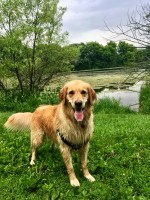
Lucy at Alimagnet Dog Park, Burnsville, Minnesota

When visiting a new town, check local community websites to find dog parks and leash laws. The town where my mom lives has a big dog park, Alimagnet Dog Park, with a pond for dog swimming and a walking path. The park is fenced, so dogs are free to be off-leash. Plus, dogs are allowed off leash during the warm months in all of the town’s outdoor hockey rinks with a gate. My mom lives in hockey-crazy Minnesota – a lot of off leash spaces!


While bringing Lucy made the trip more difficult in some ways – and certainly created a problem for our family visit in Door County – it also made it easier to meet people. Lucy basked in all of the extra attention as people of all ages told me delightful stories about their dog “at home.”

My morning walks with Lucy were quiet times to explore and wander. I found some of the murals in Sudbury, Ontario while my son was still sleeping. I watched the sun rise over the ball field where I used to play as a kid. While walking Lucy at dawn along Niagara Falls, I met a man from Michigan who told me about his dog, a 130 lb. chocolate lab. Named “Fudge.”

I want to meet Fudge.

Note: The manager at the Sturgeon Bay, WI Best Western did pay me a visit the next morning and offered to let me keep the dog in the room unattended, but it was too late at that point as we were already packing up to go to the White Birch Inn.

Images, below: Lucy at Whitefish Dunes State Park; Fire tower in Sturgeon Bay and a view from it; Sturgeon Bay waterfront and drawbridge; white thistle that is rare and specific to the Whitefish Dunes area; Lucy on the dog beach of Lake Michigan; Spoon Bridge and Cherry with Minneapolis skyline; Minnehaha Falls, Minneapolis, Minnesota; Sebastian Joe’s, Minneapolis; chillin’ with my pal Snoops at Valleyfair, Shakopee, Minnesota; Niagara Falls from the Canadian side; and Lucy at Niagara Falls at dawn.

To leave a comment, please fill out this form:

Go back

Your message has been sent

Warning
Warning
Warning
Warning

Warning.

And away we go

dogs, travel, Uncategorized
LUCY with triptik_IMG_5674

Lucy studies the map.

Fayston, Vermont. For the first time in many years, my summer calendar is OPEN. Blank spaces for days and days. No work, at least not much. No events. At least none that I HAD to attend. No obligations. At least none that I’m aware. So when my mom asked me to visit her back home in Minnesota instead of her flying East, I said o.k.

What if I drove? I posed this question out loud one evening last March when my son was home from college. He said if I drove, he’d go, too. What? Really?! He said we could take our cameras and make a road trip out of it. Over the next several weeks, I kept asking him if he still wanted to go. I expected he’d think about all those hours in the car with mom and change his mind. He didn’t.

Well, you can’t leave me with three dogs all that time, said my husband. I can’t take them all to work with me.

Which one don’t you want to take to work? I asked. Lucy was his answer.

So now my trip home is a two-week road trip with my son Erik and dog Lucy on a route that will take us through Niagra Falls and a bit of Ontario. After several days with mom in Minnesota, Lucy, Erik and I will meet up with my dad and stepmom in Door County, Wisconsin before looping back through Ontario then Montreal, Quebec, then home to Vermont. I used the on-line AAA TripTik route planner, which made the task very simple.

IMG_5643

Sorry, Charlie. I will miss you terribly – we’ll Facetime! And you’ll have lots of fun with Linus. I’ll miss Linus, too.  Lucy’s not nearly as good of a lap dog.

Preparations have preoccupied me for weeks. I researched and read Canadian and U.S. information about crossing the border with a dog: Dogs must be in good health and a rabies certificate from the vet must be presented to the border agent along with payment of a $30 fee. I coordinated our plans with my parents, finalized our route, and then made hotel reservations at pet-friendly places that welcome bigger dogs. I also needed to attend to other travel details: obtaining a copy Lucy’s vet records (that was easy – thank you Dr. Roy’s office); arranging an oil change for my car; emptying a ridiculous amount of old photo files from my computer to make room for new photo files; changing some money so I have Canadian funds to pay the pet fee at the border; and shopping for a new pair of sneakers.

The car is packed. My camera battery is fully charged. And away we go!

I will post a photo gallery from our trip in next month’s article here on wagmorevt.com. For daily road trip photos, please follow me, @skimor, on Instagram!

Picture perfect: Tips for taking dog portraits

dogs, How-to, Uncategorized
RS_welcoming committee 2017

Lucy, Charlie Brown, and Linus sit for a portrait outside my front door. This “welcome mat” was shot using my iPhone.

This post is written in response to the requests I’ve received for tips on photographing dogs. Photography, in general, is subject about which A LOT has been written, so I’m going to hit on quick and simple ideas that I’ve found useful with my dogs. I’ll “focus” on these areas: dog wrangling, light, composition, equipment, and editing for taking dog portraits.

1. Dog wrangling. 

linus portrait 2017

Linus is staring at the treat in my hand. Ths “stay” command allows a few seconds to focus and press the shutter a few times so I can choose the image I want.  Yes, Linus enjoyed the treat!

Use basic commands of “sit,” “stay” and “come” when taking dog photos. Photo sessions double as training sessions! I have noticed an improvement in my dogs’ response to “stay” since I’ve been taking more frequent squad photos. When Linus sees the camera, he will sit before I even give the command. Reward and praise – and be patient.


RS_CB_Foggy forest

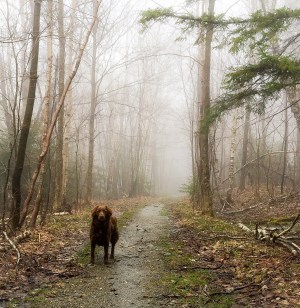
Charlie on a foggy morning walk.  I liked the mystery created by the fog but had to lighten up the image with editing to see Charlie a bit better.

2. Light. Take note of the light source and light direction before you start shooting. Light is important for evoking emotion and capturing details. The topic of light in photography is too broad to discuss in depth here. However, here are a few thoughts:

  • Consider what you’re trying to shoot then find the right light. I prefer natural light, whether outside or inside next to a window. Early morning and late afternoon provide better light than full sun midday when shadows will be strong and could make your image striped or dappled. If the sun is bright, move into the shade for even light and no squinting. Shade on a light-colored sidewalk or on sand will yield more true colors than shade cast by bushes on the grass, which will give a greenish cast.
  • Bright light will better define the action at high shutter speeds for action shots.
  • Fog and mist create drama.
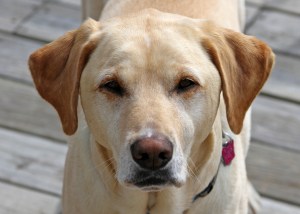
  • Generally, you will need more light to photograph a dark colored dog like my Charlie Brown than you will need for a light colored dog like Lucy or Linus.
RS_B&W_sleeping linus

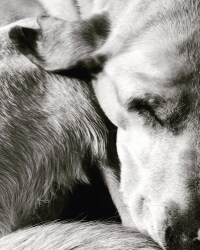
Linus, giving me the eye. Black & white shows texture well.  Also, note the circular (triangular?) composition of the dog’s body around the shadow.

Optional exercise: Try converting your images to black and white and discover the lessons in contrast and texture to be learned from black and white photography. Also, experiment with apps (some of my favorites are listed under the equipment heading) and their settings and filters to figure out what you like the best in your images.

3. Composition, or how the viewer’s eye moves around the image, is another topic too broad for this post to really cover well. That said, the viewer’s eye will be attracted to the lightest spot (usually), so pick a focal point that is light, such as the eyes.

  • Before you start, think about what emotion you’re trying to show or what the story is you’re telling – your focus, so to speak. Also, take the time to look at your surroundings with your photo in mind. An uncluttered background puts the attention on your subject for a classic portrait. If you are shooting a landscape, have your dog be the focal point for an interesting composition.
  • For a basic portrait, focus on the dog’s eyes.
  • Shoot with the camera at dog-eye level.  This tip is also useful when shooting human subjects.  Also, try holding the camera lower than your subject or directly above for a different view – play with the angles!

    RS_Lucy portrait in leaves_2017

    Lucy poses during a recent walk in the woods. I called her name to get her attention as I hit the shutter.  She was above me on a rock ledge so I could stand when I shot the image. This was shot with my iPhone.

  • Hold a treat behind or above the lens so the dogs look directly into the camera. Or make a noise to attract their attention to you, behind the camera, for a view of the subject’s face. Profile or 3/4 views also make lovely portraits, so please don’t think there is only one right way. Photos of paws, or a nose, or even a tongue tell a story about personality.
  • Pay attention to shadows and reflections – they can really enhance your composition or detract by fighting for attention with your subject.

4. Equipment: Smartphones work just fine! Use what you have, and learn how to use it. If you’re like me, the camera always in your pocket is your smartphone. The newer smartphones have good cameras, so invest a little time in learning how to use the camera and take advantage of the extra features available with apps. While my Canon 7D DSLR takes awesome photos, it’s not always convenient to carry. I tend to leave it at home when I go out on a hike and use my iPhone.

Remember, with a smartphone’s camera on (or open), tap on the area you want to be in focus. The smartphone camera will want to focus on the closest object, which on a dog’s face is the nose, so tapping on the eyes on the screen will tell the camera otherwise.

With a few apps, shutter speed and aperture can be set to better control a smartphone’s camera. These two sets of photography numbers do two different things.

RS_Lucy on the ball

Lucy is frozen in mid-air by setting my iPhone’s shutter speed to 1/1000 using the CameraPlus Pro app.  The morning was dark, so the image is dark, even after editing.

  • Shutter speed: the larger the number, the crisper – or more frozen – the action will be. 1/1000 freezes Lucy’s hair mid-leap. A setting this high works best in bright light.
  • Aperture: Or the f-stop number; the smaller the number (portraits), the more blurry the background will be. The larger the number, the more will be in focus (landscapes). Start with setting either the shutter speed or the aperture leaving whichever you don’t choose on “auto” until you become more comfortable with the settings.
  • Steady the camera. Make yourself into a tripod: Decrease camera-shake by holding or leaning on something as you hit the shutter or putting your camera on something. Make sure your setting for stabilization is “on.” Exhale as you hit the shutter.

Some of my favorite apps for my iPhone include Camera Pro Plus (costs a few dollars, but it’s great for setting shutter speed and easy editing), Slow Shutter (for low light and long exposures), and PicsArt (great for adding text or fun filters). I also use Photoshop.

5. Editing apps can really make a difference between a good image and a great one, and apps only take a few seconds to use. While editing tools cannot un-blur a blurry image, they can improve lighting, lighten up shadows, boost color, remove unwanted objects or even the entire background, and crop to improve the composition. Filters on apps can change the mood with a single tap.

Different apps offer different filters and some of my favorites are on the Photoshop Express app. PicsArt has filters that “convert” your photo into a “painting.” The Camera Plus Pro app has a wonderful Clarity Pro feature, under “The Lab” tab, which allows one to adjust the amount of intensity and vibrancy not offered on the free version. The free clarity feature gives results that are a bit overdone for my taste, but try it to see for yourself before you spend money on the Pro version. (I don’t receive any compensation from these app mentions.)


RS_Charlie eyes on it

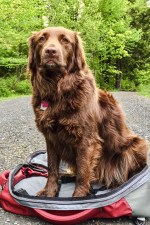
Charlie Brown focuses on the treat. I’ve focused the camera on his eyes to better show his expression. This was shot with my Canon 7D.

6. Have fun! The most important thing is to have fun with your dog. During training time, have your camera handy but keep the sessions short. If you want a big family portrait, practice often with your dog before you gather the people.  Take a walk, and take some photos along the way.  Your dog will love the walk – and the extra attention – and you’ll be taking wonderful photos to show off your beloved pooch!